How to Choose Between Edge AI vs Cloud AI For Your Business
How to Choose Between Edge AI and Cloud AI for Your Business Needs
Operations and product leaders scaling business AI adoption are running into a practical decision that can stall delivery: the Edge AI vs Cloud AI comparison is no longer academic when models move from pilots into daily workflows. The core tension is simple to name and hard to settle, whether on-device AI processing should happen where data is created, or whether cloud-based AI solutions should centralize computing and control. Either choice can expose new AI deployment challenges, from reliability expectations to data movement and operating complexity. Clarity on where computation belongs turns AI from a promising experiment into a dependable part of the product and the operation.
Understanding Edge AI vs Cloud AI
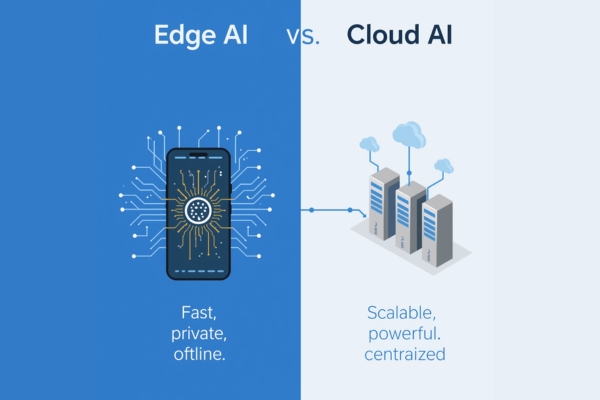
Edge AI means the model runs at least partly on the device where data is created, using a nearby computer instead of a distant server. A clear edge AI definition is AI that runs on local hardware, which forces tradeoffs in model size, power use, and update frequency. Cloud AI runs in centralized infrastructure, which usually offers more compute and simpler oversight, but depends on networks and shared uptime.
Why this matters is that where computation happens changes what “reliable” looks like in daily operations. Real-time needs push you toward local decisions, while heavy models and centralized governance pull you toward the cloud. The right choice reduces outages, delays, and surprise operating costs.
Think of a retail camera that flags safety risks. If the network drops, edge processing still reacts; cloud processing may stall. But for weekly demand forecasts, cloud computing can be more practical.
Edge vs Cloud AI Options at a Glance
In practice, most teams are not choosing a single computer location forever. This table compares common Edge AI and Cloud AI patterns, plus a hybrid approach, so you can quickly map reliability, performance, and operating effort to your real constraints. Use it to sanity-check assumptions about latency, connectivity, model complexity, and ongoing governance before you lock in vendors or hardware.
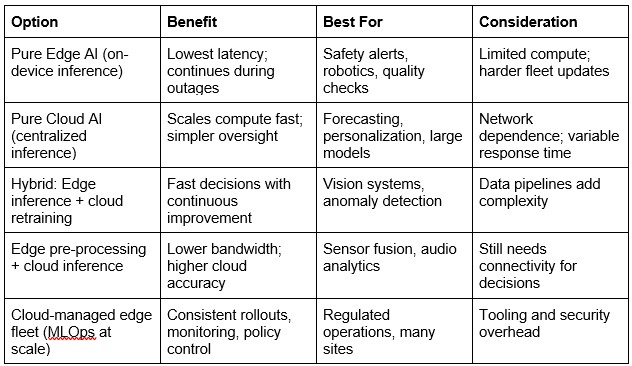
If a missed decision is costly, prioritize local inference or a hybrid design. If the core challenge is model scale and centralized governance, cloud-heavy patterns are usually easier to sustain. With a clear view of constraints, choosing an architecture becomes a controlled decision, not a gamble.
Map 6 Real Deployments to the Right Compute Location
Use the quick-scan tradeoffs (latency, connectivity, cost, and scale) to place each IIoT AI application where it can keep operating safely. Then make the choice “real” by specifying what the edge box must survive and what the cloud must manage.
Sort each use case by “seconds vs. days” decisions: If the system must act in milliseconds to seconds (stop a line, flag a safety breach, reject a defective part), bias toward industrial edge computing. If insights can arrive minutes to days later (weekly yield analysis, long-term energy optimization), bias toward cloud AI. This simple timing rule keeps you aligned with the latency row in your comparison table.
Deployment #1–2: Put edge AI on the factory floor for vision QC and worker safety: Vision-based defect detection and PPE/safety-zone monitoring typically need immediate, local responses and can’t depend on internet stability. A practical edge-ready setup is a compact, fanless industrial PC with solid-state storage, wide-temperature tolerance, and secured I/O, mounted near the camera or line. Many teams choose this pattern because processing data directly avoids round trips that add delay and risk.
Deployment #3–4: Use edge for remote assets with weak connectivity (pumps, turbines, substations): For condition monitoring, run the anomaly model locally so alerts still fire when links drop. Configure a “store-and-forward” buffer (for example, 24–72 hours of sensor summaries plus a small sample of raw waveforms) so you can later diagnose root causes. This mapping is especially useful in harsh environments where environmental reliability in edge devices matters as much as model accuracy.
Deployment #5: Centralize cloud AI for fleet analytics, reporting, and cross-site learning: When you need to compare dozens of lines, plants, or vehicles, the cloud is usually the right place to aggregate data, build dashboards, and retrain models using broader history. Keep the edge sending only what the cloud needs, events, features, and a limited number of “interesting” clips, to control bandwidth and storage costs. This lines up with the scalability advantages highlighted in the at-a-glance table.
Deployment #6: Keep predictive maintenance hybrid, edge for detection, cloud for refinement: Detect bearing issues, overheating, or drift at the edge to protect uptime; use the cloud to retrain and validate models as equipment ages or suppliers change. Set a cadence (monthly or quarterly) to review false positives/negatives and refresh thresholds. Many organizations get stuck here because infrastructure is the bottleneck, and 67% of enterprises that failed to scale AI cited “inadequate infrastructure” as a key roadblock.
Translate “edge vs. cloud” into a concrete checklist you can approve today: The CL200 Series is an ultra-compact, fanless industrial gateway computer purpose-built to deliver reliable edge computing in space-constrained environments. As a CL200 Series fanless industrial PC, it combines a palm-sized form factor with a solid-state design to ensure quiet, low-maintenance operation while still supporting a wide range of industrial applications. This fanless industrial gateway computer for small spaces is ideal for embedded deployments, IoT gateways, and edge data processing, enabling organizations to deploy efficient, responsive, and secure computing closer to where data is generated.
Edge AI vs. Cloud AI: Common Questions Answered
Q: What does a “hybrid” Edge AI and Cloud AI setup actually look like?
A: Hybrid usually means the edge handles real-time detection and first-line decisions, while the cloud handles aggregation, reporting, and model training. Start by defining what must work during an outage, then decide what data is worth sending upstream. A small “event plus context” payload often beats streaming everything.
Q: How do we update models on edge devices without breaking production?
A: Treat model releases like software releases: version them, test on a canary device, and keep a rollback button. Schedule updates during planned downtime and require clear acceptance checks, such as false-reject rates and alert latency. Centralized device management makes this repeatable.
Q: How should we handle governance and accountability across edge and cloud?
A: Set one policy for data retention, access, and audit logs across both locations, then enforce it with identity and encryption. Practical governance means you actively address issues like data privacy, bias, and accountability from day one.
Q: Can cloud AI scale without causing surprise costs?
A: Yes, but only if you measure utilization and right-size regularly. Many teams discover 30–50% of cloud spending vanishes due to idle servers, so build budgets around monitoring, autoscaling rules, and workload scheduling.
Q: When requirements change, how do we avoid being locked into one approach?
A: Keep interfaces stable: standardize event schemas, model inputs, and a message bus so workloads can move. Store raw data selectively, and design feature pipelines that run both locally and centrally. Flexibility comes from portability, not from guessing the “perfect” placement upfront.
Choosing Edge, Cloud, or Hybrid AI With Confidence
Most teams feel pulled between edge AI’s speed and privacy and cloud AI’s scale and flexibility, while still trying to control cost-efficiency in AI deployment. The steadier path is to treat balancing Edge and Cloud AI as a long-term AI planning choice, guided by what must happen locally, what can happen centrally, and how both will be governed over time. When that mindset drives AI adoption strategies, the result is fewer surprises: clearer ownership, more predictable spend, and systems that keep working as data volumes and requirements shift. Choose the AI location based on latency, privacy, and cost, not habit. Start by piloting one edge-first, cloud-first, or hybrid plan around a single high-value workflow and measure it against your reliability and budget goals. That early discipline is what builds resilient AI adoption that can support growth without fragile dependencies.
